

Latest Professional-Machine-Learning-Engineer Pass Guaranteed Exam Dumps Certification Sample Questions
New Professional-Machine-Learning-Engineer Test Materials & Valid Professional-Machine-Learning-Engineer Test Engine
Google Professional Machine Learning Engineer certification exam is a comprehensive exam that covers a wide range of topics related to machine learning. Professional-Machine-Learning-Engineer exam is designed to test the knowledge and skills of professionals in areas such as data preprocessing, model training, model tuning, model deployment, and monitoring. Professional-Machine-Learning-Engineer exam also covers topics such as machine learning frameworks, data analysis, and data visualization.
Google Professional Machine Learning Engineer certification is a highly valued and sought-after certification in the field of machine learning. Google Professional Machine Learning Engineer certification is designed to validate the skills and expertise of professionals who are responsible for designing, building, managing, and deploying machine learning models at scale using Google Cloud technologies. Google Professional Machine Learning Engineer certification is aimed at professionals who have already acquired foundational knowledge of machine learning and are looking to enhance their skills and knowledge.
NEW QUESTION # 132
A city wants to monitor its air quality to address the consequences of air pollution. A Machine Learning Specialist needs to forecast the air quality in parts per million of contaminates for the next 2 days in the city. As this is a prototype, only daily data from the last year is available.
Which model is MOST likely to provide the best results in Amazon SageMaker?
- A. Use the Amazon SageMaker Linear Learner algorithm on the single time series consisting of the full year of data with a predictor_typeof classifier.
- B. Use the Amazon SageMaker Linear Learner algorithm on the single time series consisting of the full year of data with a predictor_typeof regressor.
- C. Use Amazon SageMaker Random Cut Forest (RCF) on the single time series consisting of the full year of data.
- D. Use the Amazon SageMaker k-Nearest-Neighbors (kNN) algorithm on the single time series consisting of the full year of data with a predictor_typeof regressor.
Answer: B
Explanation:
Explanation/Reference: https://aws.amazon.com/blogs/machine-learning/build-a-model-to-predict-the-impact-of-weather- on-urban-air-quality-using-amazon-sagemaker/?ref=Welcome.AI
NEW QUESTION # 133
You work at a gaming startup that has several terabytes of structured data in Cloud Storage. This data includes gameplay time data user metadata and game metadata. You want to build a model that recommends new games to users that requires the least amount of coding. What should you do?
- A. Read data to a Vertex Al Workbench notebook Use TensorFlow to train a two-tower model.
- B. Load the data in BigQuery Use BigQuery ML to train a matrix factorization model.
- C. Load the data in BigQuery Use BigQuery ML to tram an Autoencoder model.
- D. Read data to a Vertex AI Workbench notebook Use TensorFlow to train a matrix factorization model.
Answer: B
Explanation:
BigQuery is a serverless data warehouse that allows you to perform SQL queries on large-scale data.
BigQuery ML is a feature of BigQuery that enables you to create and execute machine learning models using standard SQL queries. You can use BigQuery ML to train a matrix factorization model, which is a common technique for recommender systems. Matrix factorization models learn the latent factors that represent the preferences of users and the characteristics of items, and use them to predict the ratings or interactions between users and items. You can use the CREATE MODEL statement to create a matrix factorization model in BigQuery ML, and specify the matrix_factorization option as the model type. You can also use the ML.
RECOMMEND function to generate recommendations for new games based on the trained model. This solution requires the least amount of coding, as you only need to write SQL queries to train and use the model. References: The answer can be verified from official Google Cloud documentation and resources related to BigQuery and BigQuery ML.
* BigQuery ML | Google Cloud
* Using matrix factorization | BigQuery ML
* ML.RECOMMEND function | BigQuery ML
NEW QUESTION # 134
You need to develop a custom TensorRow model that will be used for online predictions. The training data is stored in BigQuery. You need to apply instance-level data transformations to the data for model training and serving. You want to use the same preprocessing routine during model training and serving. How should you configure the preprocessing routine?
- A. Create a BigQuery script to preprocess the data, and write the result to another BigQuery table.
- B. Create a preprocessing function that reads and transforms the data from BigQuery Create a Vertex Al custom prediction routine that calls the preprocessing function at serving time.
- C. Create a pipeline in Vertex Al Pipelines to read the data from BigQuery and preprocess it using a custom preprocessing component.
- D. Create an Apache Beam pipeline to read the data from BigQuery and preprocess it by using TensorFlow Transform and Dataflow.
Answer: D
Explanation:
According to the official exam guide 1 , one of the skills assessed in the exam is to "design, build, and productionalize ML models to solve business challenges using Google Cloud technologies". TensorFlow Transform 2 is a library for preprocessing data with TensorFlow. TensorFlow Transform enables you to define and execute distributed pre-processing or feature engineering functions on large data sets, and then export the same functions as a TensorFlow graph for re-use during training or serving. TensorFlow Transform can handle both instance-level and full-pass data transformations. Apache Beam 3 is an open source framework for building scalable and portable data pipelines. Apache Beam supports both batch and streaming data processing. Dataflow 4 is a fully managed service for running Apache Beam pipelines on Google Cloud. Dataflow handles the provisioning and management of the compute resources, as well as the optimization and execution of the pipelines. Therefore, option D is the best way to configure the preprocessing routine for the given use case, as it allows you to use the same preprocessing logic during model training and serving, and leverage the scalability and performance of Dataflow. The other options are not relevant or optimal for this scenario. References :
* Professional ML Engineer Exam Guide
* TensorFlow Transform
* Apache Beam
* Dataflow
* Google Professional Machine Learning Certification Exam 2023
* Latest Google Professional Machine Learning Engineer Actual Free Exam Questions
NEW QUESTION # 135
You are training an ML model on a large dataset. You are using a TPU to accelerate the training process You notice that the training process is taking longer than expected. You discover that the TPU is not reaching its full capacity. What should you do?
- A. Increase the number of epochs
- B. Increase the learning rate
- C. Decrease the learning rate
- D. Increase the batch size
Answer: D
Explanation:
The best option for training an ML model on a large dataset, using a TPU to accelerate the training process, and discovering that the TPU is not reaching its full capacity, is to increase the batch size. This option allows you to leverage the power and simplicity of TPUs to train your model faster and more efficiently. A TPU is a custom-developed application-specific integrated circuit (ASIC) that can accelerate machine learning workloads. A TPU can provide high performance and scalability for various types of models, such as linear regression, logistic regression, k-means clustering, matrix factorization, and deep neural networks. A TPU can also support various tools and frameworks, such as TensorFlow, PyTorch, and JAX. A batch size is a parameter that specifies the number of training examples in one forward/backward pass. A batch size can affect the speed and accuracy of the training process. A larger batch size can help you utilize the parallel processing power of the TPU, and reduce the communication overhead between the TPU and the host CPU. A larger batch size can also help you avoid overfitting, as it can reduce the variance of the gradient updates. By increasing the batch size, you can train your model on a large dataset faster and more efficiently, and make full use of the TPU capacity1.
The other options are not as good as option D, for the following reasons:
Option A: Increasing the learning rate would not help you utilize the parallel processing power of the TPU, and could cause errors or poor performance. A learning rate is a parameter that controls how much the model is updated in each iteration. A learning rate can affect the speed and accuracy of the training process. A larger learning rate can help you converge faster, but it can also cause instability, divergence, or oscillation. By increasing the learning rate, you may not be able to find the optimal solution, and your model may perform poorly on the validation or test data2.
Option B: Increasing the number of epochs would not help you utilize the parallel processing power of the TPU, and could increase the complexity and cost of the training process. An epoch is a measure of the number of times all of the training examples are used once in the training process. An epoch can affect the speed and accuracy of the training process. A larger number of epochs can help you learn more from the data, but it can also cause overfitting, underfitting, or diminishing returns. By increasing the number of epochs, you may not be able to improve the model performance significantly, and your training process may take longer and consume more resources3.
Option C: Decreasing the learning rate would not help you utilize the parallel processing power of the TPU, and could slow down the training process. A learning rate is a parameter that controls how much the model is updated in each iteration. A learning rate can affect the speed and accuracy of the training process. A smaller learning rate can help you find a more precise solution, but it can also cause slow convergence or local minima. By decreasing the learning rate, you may not be able to reach the optimal solution in a reasonable time, and your training process may take longer2.
Reference:
Preparing for Google Cloud Certification: Machine Learning Engineer, Course 2: ML Models and Architectures, Week 1: Introduction to ML Models and Architectures Google Cloud Professional Machine Learning Engineer Exam Guide, Section 2: Architecting ML solutions, 2.1 Designing ML models Official Google Cloud Certified Professional Machine Learning Engineer Study Guide, Chapter 4: ML Models and Architectures, Section 4.1: Designing ML Models Use TPUs Triose phosphate utilization and beyond: from photosynthesis to end ...
Cloud TPU performance guide
Google TPU: Architecture and Performance Best Practices - Run
NEW QUESTION # 136
You work at an organization that maintains a cloud-based communication platform that integrates conventional chat, voice, and video conferencing into one platform. The audio recordings are stored in Cloud Storage. All recordings have an 8 kHz sample rate and are more than one minute long. You need to implement a new feature in the platform that will automatically transcribe voice call recordings into a text for future applications, such as call summarization and sentiment analysis. How should you implement the voice call transcription feature following Google-recommended best practices?
- A. Use the original audio sampling rate, and transcribe the audio by using the Speech-to-Text API with synchronous recognition.
- B. Use the original audio sampling rate, and transcribe the audio by using the Speech-to-Text API with asynchronous recognition.
- C. Upsample the audio recordings to 16 kHz. and transcribe the audio by using the Speech-to-Text API with asynchronous recognition.
- D. Upsample the audio recordings to 16 kHz. and transcribe the audio by using the Speech-to-Text API with synchronous recognition.
Answer: C
NEW QUESTION # 137
You built a custom ML model using scikit-learn. Training time is taking longer than expected. You decide to migrate your model to Vertex AI Training, and you want to improve the model's training time. What should you try out first?
- A. Train your model with DLVM images on Vertex AI, and ensure that your code utilizes NumPy and SciPy internal methods whenever possible.
- B. Train your model in a distributed mode using multiple Compute Engine VMs.
- C. Train your model using Vertex AI Training with GPUs.
- D. Migrate your model to TensorFlow, and train it using Vertex AI Training.
Answer: C
Explanation:
Option A is incorrect because migrating your model to TensorFlow, and training it using Vertex AI Training, is not the easiest way to improve the model's training time. TensorFlow is a framework that allows you to create and train ML models using Python or other languages. Vertex AI Training is a service that allows you to train and optimize ML models using built-in algorithms or custom containers. However, this option requires significant code changes, as TensorFlow and scikit-learn have different APIs and functionalities. Moreover, this option does not leverage the parallelism or the scalability of the cloud, as it only uses a single instance.
Option B is incorrect because training your model in a distributed mode using multiple Compute Engine VMs, is not the most convenient way to improve the model's training time. Compute Engine is a service that allows you to create and manage virtual machines that run on Google Cloud. You can use Compute Engine to run your scikit-learn model in a distributed mode, by using libraries such as Dask or Joblib. However, this option requires more effort and resources than option D, as it involves creating and configuring the VMs, installing and maintaining the libraries, and writing and running the distributed code.
Option C is incorrect because training your model with DLVM images on Vertex AI, and ensuring that your code utilizes NumPy and SciPy internal methods whenever possible, is not the most effective way to improve the model's training time. DLVM (Deep Learning Virtual Machine) images are preconfigured VM images that include popular ML frameworks and tools, such as TensorFlow, PyTorch, or scikit-learn1. You can use DLVM images on Vertex AI to train your scikit-learn model, by using a custom container. NumPy and SciPy are libraries that provide numerical and scientific computing functionalities for Python. You can use NumPy and SciPy internal methods to optimize your scikit-learn code, as they are faster and more efficient than pure Python code2. However, this option does not leverage the parallelism or the scalability of the cloud, as it only uses a single instance. Moreover, this option may not have a significant impact on the training time, as scikit-learn already relies on NumPy and SciPy for most of its operations3.
Option D is correct because training your model using Vertex AI Training with GPUs, is the best way to improve the model's training time. A GPU (Graphics Processing Unit) is a hardware accelerator that can perform parallel computations faster than a CPU (Central Processing Unit)4. Vertex AI Training is a service that allows you to train and optimize ML models using built-in algorithms or custom containers. You can use Vertex AI Training with GPUs to train your scikit-learn model, by using a custom container and specifying the accelerator type and count5. By using Vertex AI Training with GPUs, you can leverage the parallelism and the scalability of the cloud, and speed up the training process significantly, without changing your code.
Reference:
DLVM images
NumPy and SciPy
scikit-learn dependencies
GPU overview
Vertex AI Training with GPUs
[scikit-learn overview]
[TensorFlow overview]
[Compute Engine overview]
[Dask overview]
[Joblib overview]
[Vertex AI Training overview]
NEW QUESTION # 138
You created a model that uses BigQuery ML to perform linear regression. You need to retrain the model on the cumulative data collected every week. You want to minimize the development effort and the scheduling cost. What should you do?
- A. Create a pipeline in Vertex Al Pipelines that executes the retraining query and use the Cloud Scheduler API to run the query weekly.
- B. Use the BigQuery API Connector and Cloud Scheduler to trigger. Workflows every week that retrains the model.
- C. Use Cloud Scheduler to trigger a Cloud Function every week that runs the query for retraining the model.
- D. Use BigQuerys scheduling service to run the model retraining query periodically.
Answer: A
Explanation:
BigQuery is a serverless data warehouse that allows you to perform SQL queries on large-scale data. BigQuery ML is a feature of BigQuery that enables you to create and execute machine learning models using standard SQL queries. You can use BigQuery ML to perform linear regression on your data and create a model. BigQuery also provides a scheduling service that allows you to create and manage recurring SQL queries. You can use BigQuery's scheduling service to run the model retraining query periodically, such as every week. You can specify the destination table for the query results, and the schedule options, such as start date, end date, frequency, and time zone. You can also monitor the status and history of your scheduled queries. This solution can help you retrain the model on the cumulative data collected every week, while minimizing the development effort and the scheduling cost. Reference:
BigQuery ML | Google Cloud
Scheduling queries | BigQuery
NEW QUESTION # 139
You work for a retail company. You have a managed tabular dataset in Vertex Al that contains sales data from three different stores. The dataset includes several features such as store name and sale timestamp. You want to use the data to train a model that makes sales predictions for a new store that will open soon You need to split the data between the training, validation, and test sets What approach should you use to split the data?
- A. Use Vertex Al random split assigning 70% of the rows to the training set, 10% to the validation set, and
20% to the test set. - B. Use Vertex Al chronological split and specify the sales timestamp feature as the time vanable.
- C. Use Vertex Al default data split.
- D. Use Vertex Al manual split, using the store name feature to assign one store for each set.
Answer: C
Explanation:
The best option for splitting the data between the training, validation, and test sets, using a managed tabular dataset in Vertex AI that contains sales data from three different stores, is to use Vertex AI default data split.
This option allows you to leverage the power and simplicity of Vertex AI to automatically and randomly split your data into the three sets by percentage. Vertex AI is a unified platform for building and deploying machine learning solutions on Google Cloud. Vertex AI can support various types of models, such as linear regression, logistic regression, k-means clustering, matrix factorization, and deep neural networks. Vertex AI can also provide various tools and services for data analysis, model development, model deployment, model monitoring, and model governance. A default data split is a data split method that is provided by Vertex AI, and does not require any user input or configuration. A default data split can help you split your data into the training, validation, and test sets by using a random sampling method, and assign a fixed percentage of the data to each set. A default data split can help you simplify the data split process, and works well in most cases.
A training set is a subset of the data that is used to train the model, and adjust the model parameters. A training set can help you learn the relationship between the input features and the target variable, and optimize the model performance. A validation set is a subset of the data that is used to validate the model, and tune the model hyperparameters. A validation set can help you evaluate the model performance on unseen data, and avoid overfitting or underfitting. A test set is a subset of the data that is used to test the model, and provide the final evaluation metrics. A test set can help you assess the model performance on new data, and measure the generalization ability of the model. By using Vertex AI default data split, you can split your data into the training, validation, and test sets by using a random sampling method, and assign the following percentages of the data to each set1: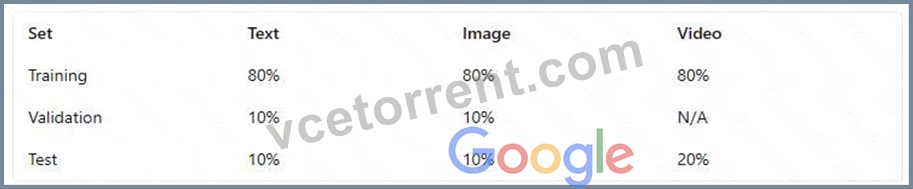
The other options are not as good as option B, for the following reasons:
* Option A: Using Vertex AI manual split, using the store name feature to assign one store for each set would not allow you to split your data into representative and balanced sets, and could cause errors or poor performance. A manual split is a data split method that allows you to control how your data is split into sets, by using the ml_use label or the data filter expression. A manual split can help you customize the data split logic, and handle complex or non-standard data formats. A store name feature is a feature that indicates the name of the store where the sales data was collected. A store name feature can help you identify the source of the data, and group the data by store. However, using Vertex AI manual split, using the store name feature to assign one store for each set would not allow you to split your data into representative and balanced sets, and could cause errors or poor performance. You would need to write code, create and configure the ml_use label or the data filter expression, and assign one store for each set. Moreover, this option would not ensure that the data in each set has the same distribution and characteristics as the data in the whole dataset, which could prevent you from learning the general pattern of the data, and cause bias or variance in the model2.
* Option C: Using Vertex AI chronological split and specifying the sales timestamp feature as the time variable would not allow you to split your data into representative and balanced sets, and could cause errors or poor performance. A chronological split is a data split method that allows you to split your data into sets based on the order of the data. A chronological split can help you preserve the temporal dependency and sequence of the data, and avoid data leakage. A sales timestamp feature is a feature that indicates the date and time when the sales data was collected. A sales timestamp feature can help you track the changes and trends of the data over time, and capture the seasonality and cyclicality of the data. However, using Vertex AI chronological split and specifying the sales timestamp feature as the time variable would not allow you to split your data into representative and balanced sets, and could cause errors or poor performance. You would need to write code, create and configure the time variable, and split the data by the order of the time variable. Moreover, this option would not ensure that the data in each set has the same distribution and characteristics as the data in the whole dataset, which could prevent you from learning the general pattern of the data, and cause bias or variance in the model3.
* Option D: Using Vertex AI random split, assigning 70% of the rows to the training set, 10% to the validation set, and 20% to the test set would not allow you to use the default data split method that is provided by Vertex AI, and could increase the complexity and cost of the data split process. A random split is a data split method that allows you to split your data into sets by using a random sampling method, and assign a custom percentage of the data to each set. A random split can help you split your data into representative and balanced sets, and avoid data leakage. However, using Vertex AI random split, assigning 70% of the rows to the training set, 10% to the validation set, and 20% to the test set would not allow you to use the default data split method that is provided by Vertex AI, and could increase the complexity and cost of the data split process. You would need to write code, create and
* configure the random split method, and assign the custom percentages to each set. Moreover, this option would not use the default data split method that is provided by Vertex AI, which can simplify the data split process, and works well in most cases1.
References:
* About data splits for AutoML models | Vertex AI | Google Cloud
* Manual split for unstructured data
* Mathematical split
NEW QUESTION # 140
You are developing a model to detect fraudulent credit card transactions. You need to prioritize detection, because missing even one fraudulent transaction could severely impact the credit card holder. You used AutoML to tram a model on users' profile information and credit card transaction data After training the initial model, you notice that the model is failing to detect many fraudulent transactions. How should you adjust the training parameters in AutoML to improve model performance? (Choose two.)
- A. Add more negative examples to the training set
- B. Increase the score threshold
- C. Decrease the score threshold.
- D. Reduce the maximum number of node hours for training
- E. Add more positive examples to the training set
Answer: C,E
NEW QUESTION # 141
You work for a social media company. You need to detect whether posted images contain cars. Each training example is a member of exactly one class. You have trained an object detection neural network and deployed the model version to Al Platform Prediction for evaluation. Before deployment, you created an evaluation job and attached it to the Al Platform Prediction model version. You notice that the precision is lower than your business requirements allow. How should you adjust the model's final layer softmax threshold to increase precision?
- A. Decrease the recall.
- B. Increase the recall
- C. Decrease the number of false negatives
- D. Increase the number of false positives
Answer: C
NEW QUESTION # 142
A company ingests machine learning (ML) data from web advertising clicks into an Amazon S3 data lake. Click data is added to an Amazon Kinesis data stream by using the Kinesis Producer Library (KPL). The data is loaded into the S3 data lake from the data stream by using an Amazon Kinesis Data Firehose delivery stream.
As the data volume increases, an ML specialist notices that the rate of data ingested into Amazon S3 is relatively constant. There also is an increasing backlog of data for Kinesis Data Streams and Kinesis Data Firehose to ingest.
Which next step is MOST likely to improve the data ingestion rate into Amazon S3?
- A. Decrease the retention period for the data stream.
- B. Increase the number of S3 prefixes for the delivery stream to write to.
- C. Add more consumers using the Kinesis Client Library (KCL).
- D. Increase the number of shards for the data stream.
Answer: D
Explanation:
Explanation/Reference:
NEW QUESTION # 143
Your company manages an application that aggregates news articles from many different online sources and sends them to users. You need to build a recommendation model that will suggest articles to readers that are similar to the articles they are currently reading. Which approach should you use?
- A. Create a collaborative filtering system that recommends articles to a user based on the user's past behavior.
- B. Encode all articles into vectors using word2vec, and build a model that returns articles based on vector similarity.
- C. Manually label a few hundred articles, and then train an SVM classifier based on the manually classified articles that categorizes additional articles into their respective categories.
- D. Build a logistic regression model for each user that predicts whether an article should be recommended to a user.
Answer: B
Explanation:
* Option A is incorrect because creating a collaborative filtering system that recommends articles to a user based on the user's past behavior is not the best approach to suggest articles that are similar to the articles they are currently reading. Collaborative filtering is a method of recommendation that uses the ratings or preferences of other users to predict the preferences of a target user1. However, this method does not consider the content or features of the articles, and may not be able to find articles that are similar in terms of topic, style, or sentiment.
* Option B is correct because encoding all articles into vectors using word2vec, and building a model that returns articles based on vector similarity is a suitable approach to suggest articles that are similar to the
* articles they are currently reading. Word2vec is a technique that learns low-dimensional and dense representations of words from a large corpus of text, such that words that are semantically similar have similar vectors2. By applying word2vec to the articles, we can obtain vector representations of the articles that capture their meaning and usage. Then, we can use a similarity measure, such as cosine similarity, to find articles that have similar vectors to the current article3.
* Option C is incorrect because building a logistic regression model for each user that predicts whether an article should be recommended to a user is not a feasible approach to suggest articles that are similar to the articles they are currently reading. Logistic regression is a supervised learning method that models the probability of a binary outcome (such as recommend or not) based on some input features (such as user profile or article content)4. However, this method requires a large amount of labeled data for each user, which may not be available or scalable. Moreover, this method does not directly measure the similarity between articles, but rather the likelihood of a user's preference.
* Option D is incorrect because manually labeling a few hundred articles, and then training an SVM classifier based on the manually classified articles that categorizes additional articles into their respective categories is not an effective approach to suggest articles that are similar to the articles they are currently reading. SVM (support vector machine) is a supervised learning method that finds a hyperplane that separates the data into different classes (such as news categories) with the maximum margin5. However, this method also requires a large amount of labeled data, which may be costly and time-consuming to obtain. Moreover, this method does not account for the fine-grained similarity between articles within the same category, or the cross-category similarity between articles from different categories.
References:
* Collaborative filtering
* Word2vec
* Cosine similarity
* Logistic regression
* SVM
NEW QUESTION # 144
You have deployed a model on Vertex AI for real-time inference. During an online prediction request, you get an "Out of Memory" error. What should you do?
- A. Use batch prediction mode instead of online mode.
- B. Apply for a quota increase for the number of prediction requests.
- C. Use base64 to encode your data before using it for prediction.
- D. Send the request again with a smaller batch of instances.
Answer: D
Explanation:
* Option A is incorrect because using batch prediction mode instead of online mode does not solve the
"Out of Memory" error, but rather changes the latency and throughput of the prediction service. Batch prediction mode is suitable for large-scale, asynchronous, and non-urgent predictions, while online prediction mode is suitable for low-latency, synchronous, and real-time predictions1.
* Option B is correct because sending the request again with a smaller batch of instances can reduce the memory consumption of the prediction service and avoid the "Out of Memory" error. The batch size is the number of instances that are processed together in one request. A smaller batch size means less data to load into memory at once2.
* Option C is incorrect because using base64 to encode your data before using it for prediction does not reduce the memory consumption of the prediction service, but rather increases it. Base64 encoding is a way of representing binary data as ASCII characters, which increases the size of the data by about
33%3. Base64 encoding is only required for certain data types, such as images and audio, that cannot be represented as JSON or CSV4.
* Option D is incorrect because applying for a quota increase for the number of prediction requests does not solve the "Out of Memory" error, but rather increases the number of requests that can be sent to the prediction service per day. Quotas are limits on the usage of Google Cloud resources, such as CPU, memory, disk, and network5. Quotas do not affect the performance of the prediction service, but rather the availability and cost of the service.
References:
* Choosing between online and batch prediction
* Online prediction input data
* Base64 encoding
* Preparing data for prediction
* Quotas and limits
NEW QUESTION # 145
You want to migrate a scikrt-learn classifier model to TensorFlow. You plan to train the TensorFlow classifier model using the same training set that was used to train the scikit-learn model and then compare the performances using a common test set. You want to use the Vertex Al Python SDK to manually log the evaluation metrics of each model and compare them based on their F1 scores and confusion matrices. How should you log the metrics?
- A.

- B.

- C.

- D.

Answer: C
Explanation:
To log the metrics of a machine learning model in TensorFlow using the Vertex AI Python SDK, you should utilize the aiplatform.log_metrics function to log the F1 score and aiplatform.log_classification_metrics function to log the confusion matrix. These functions allow users to manually record and store evaluation metrics for each model, facilitating an efficient comparison based on specific performance indicators like F1 scores and confusion matrices. References: The answer can be verified from official Google Cloud documentation and resources related to Vertex AI and TensorFlow.
* Vertex AI Python SDK reference | Google Cloud
* Logging custom metrics | Vertex AI
* Migrating from scikit-learn to TensorFlow | TensorFlow
NEW QUESTION # 146
You are building a linear regression model on BigQuery ML to predict a customer ' s likelihood of purchasing your company ' s products. Your model uses a city name variable as a key predictive component. In order to train and serve the model, your data must be organized in columns. You want to prepare your data using the least amount of coding while maintaining the predictable variables. What should you do?
- A. Use Cloud Data Fusion to assign each city to a region labeled as 1, 2, 3, 4, or 5r and then use that number to represent the city in the model.
- B. Create a new view with BigQuery that does not include a column with city information
- C. Use Dataprep to transform the state column using a one-hot encoding method, and make each city a column with binary values.
- D. Use TensorFlow to create a categorical variable with a vocabulary list Create the vocabulary file, and upload it as part of your model to BigQuery ML.
Answer: C
Explanation:
One-hot encoding is a technique that converts categorical variables into numerical variables by creating dummy variables for each possible category. Each dummy variable has a value of 1 if the original variable belongs to that category, and 0 otherwise 1 . One-hot encoding can help linear regression models to capture the effect of different categories on the targe t variable without imposing any ordinal relationship among them
2 . Dataprep is a service that allows you to explore, clean, and transform your data for analysis and machine learning. You can use Dataprep to apply one-hot encoding to your city name variable and make each city a column with binary values 3 . This way, you can prepare your data using the least amount of coding while maintaining the predictive variables. Therefore, using Dataprep to transform the state column using a one-hot encoding method is the best option for this use case.
References:
One Hot Encoding: A Beginner's Guide
One-Hot Encoding in Linear Regression Models
Dataprep documentation
NEW QUESTION # 147
......
Professional-Machine-Learning-Engineer Sample with Accurate & Updated Questions: https://prepaway.vcetorrent.com/Professional-Machine-Learning-Engineer-valid-vce-torrent.html