

Latest Verified & Correct Real Estate New-Jersey-Real-Estate-Salesperson Questions & Answers Daily Updated
100% Pass Guaranteed Download New Jersey Real Estate Exam PDF Q&A
NEW QUESTION # 15
Which of the following statements in an advertisement would be an example of non-discriminatory language under HUD's Fair Housing Advertising Guidelines?
- A. nice home ideal for any family with children
- B. located within walking distance to a great Catholic school
- C. apartment available. No pets or children allowed
- D. female seeking female roommate
Answer: A
Explanation:
HUD Fair Housing Advertising Guidelines prohibit words that indicate preference or limitation based on protected classes (race, sex, religion, familial status, etc.).
"Female seeking female roommate" = gender preference # discriminatory.
"No pets or children allowed" = familial status discrimination.
"Catholic school" = religious preference.
"Ideal for any family with children" = permitted because it is descriptive and not exclusionary.
Correct answer = B.
Reference: HUD Fair Housing Advertising Guidelines; NJ Real Estate Salesperson Study Guide, Chapter on Fair Housing.
NEW QUESTION # 16
If a salesperson or broker-salesperson maintains a webpage that is not linked to the webpage of their broker, the licensee's webpage must display the name of the broker as well as the
- A. address of the broker's main office.
- B. broker's telephone number.
- C. address of the branch office from which the licensee operates.
- D. broker's email address.
Answer: A
Explanation:
Under NJREC advertising rules (N.J.A.C. 11:5-6.1), any licensee maintaining an independent website (not directly linked to the broker's official site) must clearly and prominently display:
The name of their employing broker, and
The main office address of the broker.
This ensures the public understands the licensee works under a supervising broker, and prevents misleading advertising. It is not sufficient to only list a branch office or email.
Therefore, the correct answer is C.
Reference: NJREC Rules and Regulations, N.J.A.C. 11:5-6.1 (Advertising Requirements).
NEW QUESTION # 17
A city has built a new library and has contacted the broker to list and sell the old library building. Which approach should the broker use to estimate the fair market value for the purpose of listing and selling this property?
- A. gross rent multiplier
- B. sales comparison
- C. income approach
- D. replacement cost
Answer: D
Explanation:
For special-purpose properties such as schools, churches, libraries, or government buildings, there are typically few comparable sales and the properties are not income-producing.
In these cases, appraisers use the cost (replacement) approach, which estimates the value by calculating the cost of replacing the structure minus depreciation, plus land value.
Correct answer: C. replacement cost.
Reference: NJ Real Estate Salesperson Study Guide, Chapter on Appraisal Methods (Cost Approach for Special-Purpose Properties).
NEW QUESTION # 18
If an owner wants to list a property for sale "as is," the listing agent should:
- A. assume that the owner will accept a relatively low price for the property.
- B. assume that the house is a "fixer-upper."
- C. question the seller as to any known defects.
- D. conclude that if the buyer later discovers defects that were not disclosed the listing agent is relieved of any responsibility.
Answer: C
Explanation:
"As is" does not relieve a seller or listing agent from disclosure obligations.
The licensee must still make reasonable inquiries about known defects.
All material facts must be disclosed, regardless of the "as is" designation.
"As is" simply means the seller will not make repairs or improvements.
Thus, the agent must ask the seller about known defects = C.
Reference: NJREC Rules and Regulations on Disclosure; NJ Real Estate Salesperson Study Guide, Chapter on Seller Disclosures and "As Is" Sales.
NEW QUESTION # 19
An intoxicated buyer made an offer on a house. The owners accepted the offer. This contract is
- A. voidable.
- B. void.
- C. unilateral.
- D. illegal.
Answer: A
Explanation:
Per the Contracts chapter of the NJ Real Estate Salesperson Pre-Licensure Course Study Guide, contractual capacity is required. Agreements entered into by a party who is intoxicated to the point of incapacity are voidable at that party's option (once sober), not void per se. The contract is not illegal, and it's bilateral (both parties promise performance), not unilateral.
* Thus, the contract is voidable by the intoxicated party.
(Reference: NJ Real Estate Salesperson Pre-Licensure Course Study Guide, Contracts-Capacity; Void vs.
Voidable Contracts.)
NEW QUESTION # 20
The main purpose of a deed is to
- A. guarantee clear title.
- B. convey title.
- C. provide documentation of legal possession.
- D. record and acknowledge title transfer.
Answer: B
Explanation:
Per the Property Ownership & Transfer section of the NJ Real Estate Salesperson Study Guide, the primary purpose of a deed is to transfer ownership (title) from the grantor to the grantee.
* A deed does not guarantee clear title (that would require a warranty or title insurance).
* A deed is not proof of possession; possession may occur without ownership.
* Recording and acknowledgment serve notice, but the deed's legal function is the act of conveyance.
Therefore, the correct answer is A: convey title.
(Reference: NJ Real Estate Salesperson Pre-Licensure Course Study Guide, Transfer of Title-Deeds.) D). verbally inform any buyer's agent of the proposed revision.
NJ Real Estate Agent said:
NEW QUESTION # 21
A property that contains a 2,500-square-foot house has a land value of $45,000. The house suffers from
$7,000 of physical depreciation and $2,500 of functional obsolescence. If the replacement cost of the house is
$75 per square foot, what is the value of the property?
- A. $223,000
- B. $232,500
- C. $178,000
- D. $187,500
Answer: A
Explanation: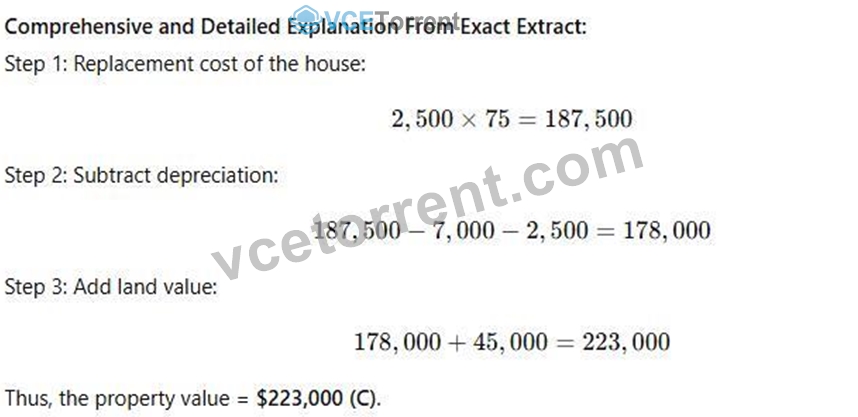
Reference: NJ Real Estate Salesperson Study Guide, Chapter on Appraisal (Cost Approach Method).
NEW QUESTION # 22
Which of the following is least likely to be considered in establishing the value of a property by the sales comparison approach?
- A. the square footage of the building
- B. the capitalization rate
- C. the date of sale
- D. the size of the lot
Answer: B
Explanation:
The sales comparison approach relies on comparing recently sold similar properties, adjusting for differences (e.g., lot size, square footage, date of sale).
The capitalization rate is used in the income approach, not the sales comparison approach.
Correct answer = B.
Reference: NJ Real Estate Salesperson Study Guide, Chapter on Appraisal Methods.
NEW QUESTION # 23
After announcing that a new city park will soon be developed, homes in the immediate area experience a rise in value. This is an example of which of the following principles of value?
- A. anticipation
- B. highest and best use
- C. contribution
- D. change
Answer: A
Explanation:
Principle of anticipation: Value is created by the expectation of future benefits (e.g., new park development).
Change: value is constantly influenced by natural and economic changes.
Contribution: value of an improvement is measured by its contribution to the property's value.
Highest and best use: most profitable legal use of the land.
Here, the increase is due to anticipated future benefits # C.
Reference: NJ Real Estate Salesperson Study Guide, Chapter on Appraisal Principles.
NEW QUESTION # 24
A home sold for $400,000. It was appraised for $402,000, and the assessed value was $320,000. Assume in this situation, the real estate transfer tax of 1% is paid by the grantee. How much will the seller owe at closing for transfer fees?
- A. $4,020
- B. $4,000
- C. $0
- D. $3,200
Answer: C
Explanation:
In New Jersey, the Realty Transfer Fee (RTF) is typically paid by the seller, but the question specifies that the tax is paid by the grantee (buyer). When the buyer pays the transfer tax, the seller does not owe any amount at closing for transfer fees.
Additionally, the RTF is calculated based on the consideration amount (sale price), not the appraised or assessed value. But since liability is shifted to the buyer here, the seller's responsibility = $0.
Reference: New Jersey Realty Transfer Fee Statute, N.J.S.A. 46:15-7; New Jersey Real Estate Salesperson Study Guide, Chapter on Closing and Transfer Taxes.
NEW QUESTION # 25
Which of the following statements would most likely be considered mere "puffing"?
- A. Children from this neighborhood have the highest SAT scores.
- B. The utility costs in this home are lower than in any other home in the neighborhood.
- C. This lot has the most beautiful view of the lake.
- D. This area is expected to increase in value by 25% within the next year.
Answer: C
Explanation:
Puffing = exaggeration or subjective opinion that no reasonable person would take as fact (e.g., "most beautiful view").
Statements of fact (e.g., predicted appreciation %, test scores, or utility costs) could be misrepresentation if untrue.
Thus, "This lot has the most beautiful view of the lake" = puffing.
Correct answer = B.
Reference: NJ Real Estate Salesperson Study Guide, Chapter on Ethics and Misrepresentation.
NEW QUESTION # 26
A married couple is purchasing a home. They ask the salesperson to advise them regarding the best way to take title. The salesperson should
- A. ask a broker to make a recommendation.
- B. decline to advise them and suggest that they consult an attorney.
- C. explain the possible types of joint ownership so they understand the options.
- D. advise them to take title as tenants by the entirety.
Answer: B
Explanation:
According to the NJ Real Estate Commission regulations on licensee conduct and the Salesperson Study Guide (Agency & Professional Practice section), licensees may explain types of ownership but must not give legal advice or recommend a specific method of taking title. Advising how to take title (e.g., tenants by the entirety, joint tenancy, tenancy in common) constitutes the practice of law. The proper action is to refer the buyers to an attorney.
Therefore, the correct answer is C.
(Reference: NJ Real Estate Salesperson Pre-Licensure Course Study Guide, Professional Responsibilities & Avoiding Unauthorized Practice of Law.)
NEW QUESTION # 27
A couple who sell their principal residence may take up to $500,000 in federal capital gains tax-free only if:
- A. at least one of them has reached the age of 65.
- B. they buy a replacement home of equal or greater value than the one being sold within a year.
- C. neither has ever used the Homesellers Exclusion in the past.
- D. they have owned and occupied the house for at least 2 of the previous 5 years.
Answer: D
Explanation:
Under IRS Section 121 Exclusion (Home Sale Exclusion Rule):
Married couples filing jointly can exclude up to $500,000 of capital gains.
They must have owned and occupied the property as their primary residence for 2 of the past 5 years.
Age 65 requirement is obsolete (repealed).
They don't need to reinvest in another home.
The exclusion can be used once every 2 years.
Correct answer = D.
Reference: Internal Revenue Code §121; NJ Real Estate Salesperson Study Guide, Chapter on Taxation.
NEW QUESTION # 28
Are electronic signatures enforceable on a real estate contract?
- A. No, because they must be signed and witnessed.
- B. Yes, because they are legal in real estate transactions.
- C. Yes, because they are allowed by the federal government.
- D. No, because they are only allowed on deeds.
Answer: B
Explanation:
Electronic signatures are legally enforceable under the federal Electronic Signatures in Global and National Commerce Act (E-SIGN Act, 2000) and the New Jersey Uniform Electronic Transactions Act (UETA, N.J.S.
A). 12A:12-1 et seq.).
These laws confirm that electronic signatures are valid and binding in real estate contracts, listings, leases, and other documents.
They are not restricted to deeds, and do not require witnessing to be valid.
Therefore, the correct answer is B.
Reference: Federal E-SIGN Act (2000); NJ Uniform Electronic Transactions Act; NJ Real Estate Salesperson Study Guide, Chapter on Contracts and Closing.
NEW QUESTION # 29
The feature that most distinguishes a joint tenancy from a tenancy in common is
- A. unity of possession.
- B. undivided interests.
- C. right of survivorship
- D. right of transfer.
Answer: C
Explanation:
Both joint tenancy and tenancy in common involve co-ownership where each co-owner holds an undivided interest and shares the right of possession. The distinguishing feature is the right of survivorship present in a joint tenancy: upon the death of one joint tenant, their interest automatically passes to the surviving joint tenants rather than being inheritable by heirs.
A (undivided interests) and B (unity of possession) exist in both forms of ownership.
D (right of transfer) also applies to both, since owners may sell or transfer their interest.
Only C (right of survivorship) uniquely characterizes joint tenancy.
(Reference: NJ Real Estate Salesperson Pre-Licensure Course Study Guide, Ownership Interests in Real Estate-Joint Tenancy vs. Tenancy in Common.)
NEW QUESTION # 30
Which of the following differentiates a bilateral contract from a unilateral contract?
- A. type of property specified in the contract
- B. number of parties involved
- C. relative value of the object of the contract
- D. performance obligations of the parties
Answer: D
Explanation:
A bilateral contract involves mutual promises where both parties are obligated to perform (e.g., a sales contract: buyer promises to pay, seller promises to transfer title).
A unilateral contract involves only one party making a promise contingent on the performance of the other (e.
g., an option contract).
Thus, the key difference is performance obligations of the parties.
Correct answer = B.
Reference: NJ Real Estate Salesperson Study Guide, Chapter on Contracts.
NEW QUESTION # 31
Which of the following can hold escrow accounts?
- A. banks, salespersons, and title companies
- B. banks, brokers, and attorneys
- C. lenders, brokers, and real estate commissions
- D. salespersons, brokers, and lenders
Answer: B
Explanation:
Under New Jersey law:
Salespersons may NOT hold escrow accounts.
Only brokers of record, attorneys, and financial institutions (banks) may lawfully maintain escrow accounts.
The Real Estate Commission itself does not hold escrow accounts.
Therefore, the correct grouping is banks, brokers, and attorneys.
Reference: NJREC Rules and Regulations, N.J.A.C. 11:5-5.1 (Trust Accounts); New Jersey Real Estate Salesperson Study Guide, Chapter on Escrow and Trust Funds.
NEW QUESTION # 32
Standard title insurance would protect a buyer:
- A. when the seller has forged an ex-partner's signature on the deed.
- B. in a purchase where the buyer had knowledge of a shed violating setback requirements.
- C. for the purchase of a property bought sight unseen where the buyer discovers a tenant living at the property.
- D. if after closing, the HOA placed a lien on the property for the previous owners' unpaid dues.
Answer: A
Explanation:
Standard title insurance protects against defects in title that existed before closing, such as forged documents, undisclosed heirs, or improperly executed deeds.
It does not cover issues arising after closing (like new HOA liens).
It does not protect against defects the buyer already knew about.
It also does not insure physical possession or condition of property.
Thus, the correct answer is A.
Reference: NJ Real Estate Salesperson Study Guide, Chapter on Title and Title Insurance.
NEW QUESTION # 33
......
New-Jersey-Real-Estate-Salesperson PDF Dumps Are Helpful To produce Your Dreams Correct QA's: https://prepaway.vcetorrent.com/New-Jersey-Real-Estate-Salesperson-valid-vce-torrent.html